
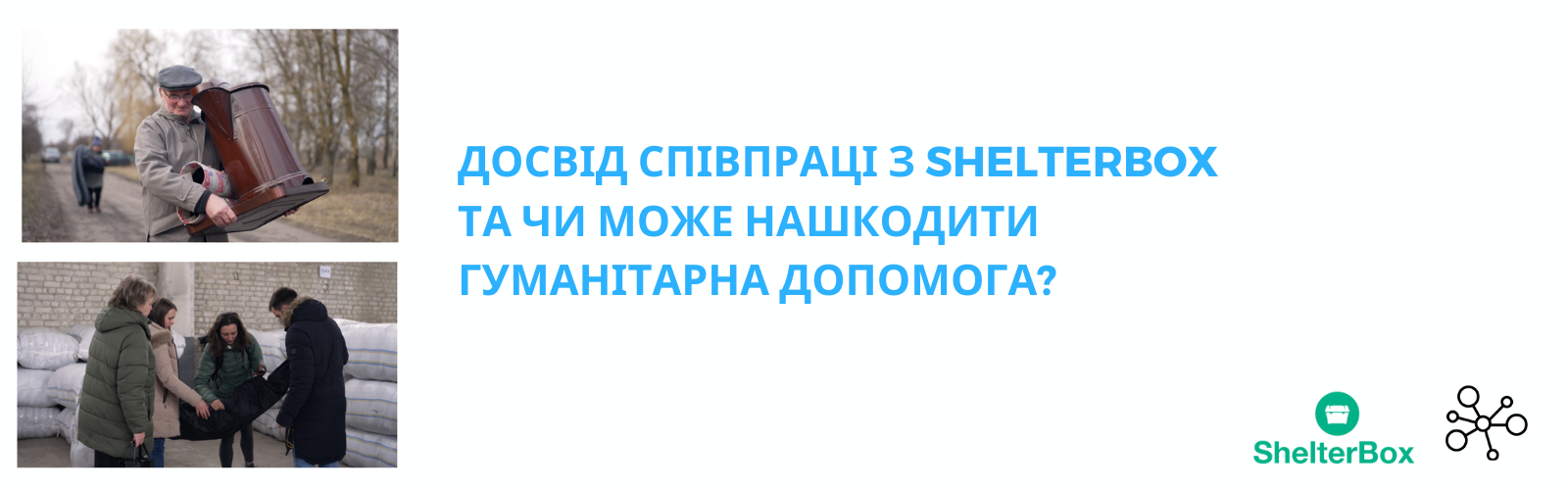
Experience of cooperation with ShelterBox and whether humanitarian aid can do harm?
You can't sell 21 trucks of humanitarian aid without making mistakes. In this article, I will tell you about the peculiarities of cooperation with international organizations and what you need to consider to make your help more effective.
My name is Victoria Zablotska. I am a fundraising manager at the National Network for the Development of Local Philanthropy. I worked on the implementation of humanitarian aid from ShelterBox in Ukraine and I want to tell you how it was.
How does the work of international donors differ from ShelterBox?
Very often, Ukrainian charitable organizations hire purely implementing partners. That is, there is an international organization that is involved in the project. It hires a Ukrainian organization purely to distribute humanitarian aid. It doesn't care about the processes in this organization, that they don't pay enough to the people involved in distribution. I would call it a parasitic partnership.
We are lucky to cooperate with the British organization ShelterBox. In working with them, our organization is an equal partner.
We met ShelterBox last fall. ShelterBox is an organization that promptly provides assistance to people in dangerous and difficult situations. We met with them live, in our office. They gave us a big stack of papers. They had printed out signs with a bunch of questions. Different ones. For example, "How do you recruit staff?", "What are your policies, procedures?", "What are your security policies?", about the board, role, mission, and implemented projects... To start cooperation, we had to fill out all these questions in English, of course. It would have taken a lot of time. In December, we invited them to a conference with community foundations in our network. After ShelterBox communicated with the project's direct implementers, they reduced the number of questions to 10-15. However, when we started talking about our next project, it turned out that we still needed to go through all the compliance processes, so they sent us a file with a number of questions again, even though we had already shown our skills and capabilities in practice.
Throughout the project, the British team was very supportive and helpful.
For example, we are in Ukraine and all our documentation has to be in Ukrainian, while in the UK it is in English. So ShelterBox translated our documentation into Ukrainian at their own expense. They also translated feedback from our community foundations and people who received help from Ukrainian to English.
We also budgeted a fairly large amount for logistics, but we managed to save money on it. With that money, we were able to increase payments to local managers because they worked harder than planned. And this is also about ShelterBox's flexibility, because they allowed us to make these changes in the budget. Mostly, in projects with donors, you can move something around a little bit in the budget, but if in SB it was enough for me to write one letter of justification, in the case of certain other organizations, it is much more work. For your understanding, it can be one letter, a second letter, an official document with explanations, wait for confirmation, provide additional explanations, change the initial project budget, and so on and so forth.
Partnership and mistakes
A lot depends on people. The ShelterBox team that worked with us is really interested in this. They are planning to come back soon to train our team and the community foundations of our network in mine safety, first aid, humanitarian law, and working with UN clusters. That is, as an organization, they respond to emergencies and sooner or later, they will leave Ukraine to help in other places. But at the same time, they want to contribute as much as possible to the development of the organizations they work with and the countries where they are involved. I think this is the specificity of the team we worked with. They are ready to advocate for our needs and present new ideas to their management and higher ups. But it is important that the heads and management of these organizations are ready for these changes. For example, when we were told to go through the compliance process for the second project, we said that we were not very comfortable with this, as we would have to spend a lot of time and resources to write down all the answers. Instead, we offered to take information about us from the UNPP (United Nations Partner Portal), since ShelterBox is part of the UN cluster system. This satisfied them, and they only asked for one of our financial documents in addition. This also shows their flexibility and adaptability.
When we talked to ShelterBox about the project feedback, we had a slide prepared with mistakes on our part and mistakes on their part. For example, they admitted that they had overestimated our ability to work with such a large amount of humanitarian aid and should have offered us to hire another person to our team sooner. Not every donor recognizes this. If we talk about our mistakes, we also have them, because working with such things is a bit difficult because you have to look several months ahead. We started talking about this project in October-November. While we were going through all these bureaucratic processes, we made a project proposal and a project agreement. Then there were legal signatures from our side and theirs. While we received the funds, while the goods were produced in Turkey and brought to Ukraine, the trucks were at customs... It took all the time. As a result, the trucks with the aid were in Ukraine at the end of January. Our assistance was designed for the winter. And even the feedback from the recipients of the aid shows that a small percentage of people used the stoves because it was no longer so urgent. That's why a quick response is important here. It is important to think not only about the now. Not much can be done in the moment. When planning similar projects, you need to think several months in advance. What will be relevant when the aid arrives?
We also made a mistake with the number of postcards to collect feedback. There weren't enough postcards for the number of people who received help. And not everyone who received a postcard could use it, because, for example, pensioners, for the most part, do not have smartphones and therefore cannot scan the QR code and fill out the feedback form.
What to do next? Can humanitarian aid support Ukraine's economy?
We have not yet closed the previous project and are already planning the next one. The new one has 3 parts: work with IDPs, work with people who have returned to the de-occupied regions, and work with hostels for IDPs. The budget turned out to be quite large. We are now discussing possible implementation options.
We did the last project very quickly, and this affected the implementation. Now we know our mistakes and will take them into account. It is difficult to predict what people will need most in 6-8 months, given the terrorist country next door to us. It is difficult, but we are trying.
Recently, we discussed with ShelterBox via video call what we can do to help people really quickly, as, for example, in the situation with the Kakhovka hydroelectric power station explosion. We are considering the possibility of keeping rapid response kits in our warehouse so that if necessary, we can immediately deliver them from the warehouse to the scene.
Another important point is that the humanitarian aid provided to Ukrainians was purchased in other countries. It might have been cheaper compared to purchases in Ukraine, such as in Turkey, but the logistics also cost money and time. ShelterBox is now ready for us to buy some of the products in Ukraine. This will reduce the time for logistics and documentation work, because we won't need a broker to work with customs. And it's a support for local Ukrainian production, because humanitarian aid, unfortunately, is very bad for Ukrainian businesses. We are interested in the development of Ukraine and entrepreneurship in particular. That is why ShelterBox is ready for us to buy part of the humanitarian aid in Ukraine, from Ukrainian producers.