
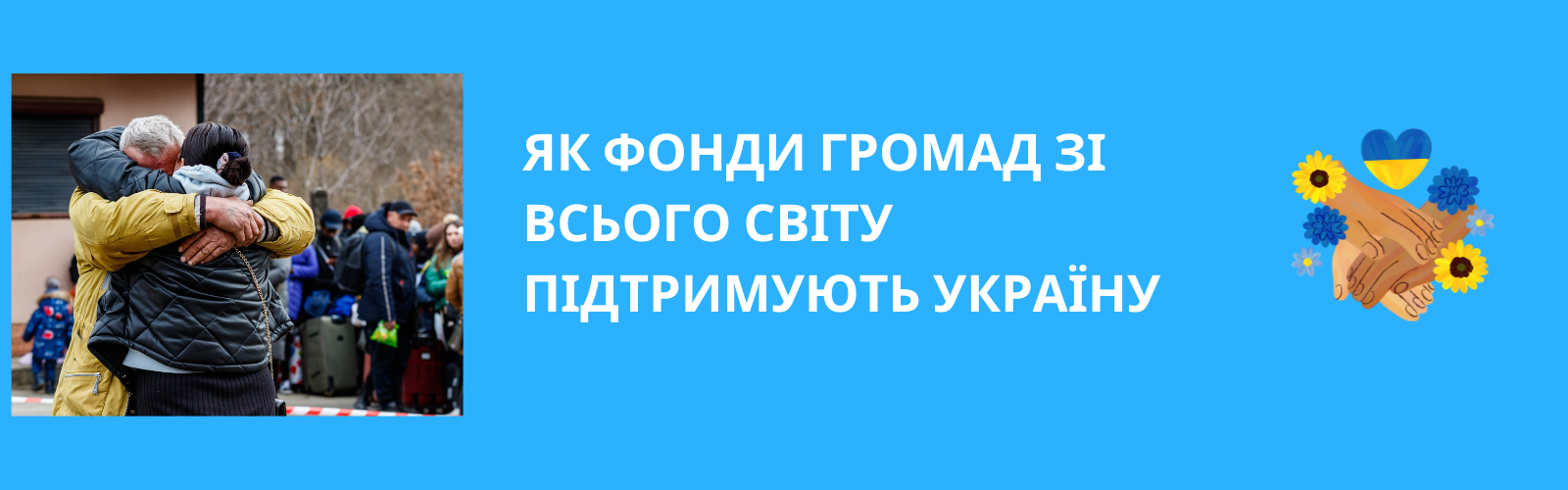
How community foundations from around the world support Ukraine
February 24, 2022 is a date that history will remember as the beginning of another European war. Russia's invasion of Ukraine has captured our thoughts and hearts for more than a year. The war is bringing destruction and a humanitarian crisis unprecedented in Europe in the past few decades, affecting progress towards the SDGs in Ukraine and around the world.
Civil society has responded quickly to support those in need. In addition to significant material assistance, European societies have demonstrated an impressive level of solidarity. The European Union has changed its migration regime, accepting Ukrainians into its communities.
In this context, community foundations have made a significant contribution to this struggle in Ukraine, neighboring countries and far beyond. They have also led local and international initiatives.
Community foundations work locally. They have a mission to build the capacity and resilience of local communities. After a year of war in Ukraine, we are thinking about our community foundation colleagues and their communities. It is hard to imagine, let alone see, the cities devastated by war.
Although words cannot express the pain caused by the war, Ukrainian community foundations continue to stand up for their cities and country. They continue their work and help their communities survive the hard times.
Ukrainian community foundations are part of a global network that has mobilized to support Ukraine. The European Community Foundation Initiative (ECFI) has functioned as a bridge since the first days of the war. Community foundations from other European countries supported Ukrainian community foundations and their communities, as well as Ukrainian refugees and migrants.
According to James Magowan of ECFI, European foundations contributed to the humanitarian crisis in various ways, including: "collecting and sending humanitarian aid, raising funds and sending money to community foundations in Ukraine and/or international organizations, and providing support to refugees. (e.g., providing supplies, transportation, advice and guidance, accommodation, etc.); grant assistance - providing financial support to NGOs for both activities and general operating expenses; networking within and outside community foundations and philanthropy - building relationships with municipalities, businesses, and non-governmental organizations.
All neighboring countries have contributed in different ways. Some examples include Poland, Slovakia, and Romania. Beata Hirt of the Healthy City Community Foundation recalls how Slovak community foundations have contributed to "collecting materials, fundraising, grants to support inclusion at the local level, supporting language courses, extracurricular activities, working with the majority to prevent and reduce negative attitudes towards Ukrainians living in our communities."
Iwona Olkowicz from the Federation of Community Foundations in Poland spoke about the contribution of Polish community foundations: "So far, we have collected and sent gifts worth more than 1,000,000 zlotys to Ukraine. These included warm clothes, blankets and sleeping bags; power banks, flashlights and radios; long-life food; hygiene items and medicines; and many other necessary things. We have allocated PLN 250,000 to refugees who have arrived in our country, mainly funding integration meetings and intercultural seminars; language and vocational courses; psychological assistance and doctor's visits; as well as school supplies and scholarships for Ukrainian children attending Polish schools. Now, thanks to a donation of 930,000 PLN we received from #AffinityTrustLimited, we can continue our activities."
European countries further away from the conflict have also mobilized resources. Magowan said: "Ireland is far away, but 'Standing with the people of Ukraine', as a recent report by the Community Foundation of Ireland puts it. Importantly, this refers to a strategic response to urgent needs. The report shows that community foundations are flexible but think long-term. The Community Foundation in Ireland engaged a task force to identify needs and help inform the use of resources. This shows the need for ongoing support."
All these efforts are seen and appreciated by Ukrainian colleagues. According to Daria Rybalchenko of the National Network for the Development of Local Philanthropy, "The European Community foundations have organized many programs in response to the war in Ukraine. Firstly, it supports Ukrainian refugees abroad as direct humanitarian aid and programs to finance initiatives for Ukrainian refugees. Secondly, it supports Ukrainian community foundations through fundraising, humanitarian aid, logistics centers and donor relations. So, through WhatsApp chat, we got several valuable donor contacts who are now supporting Ukrainian community foundations. In addition, Root and Wings Foundation put us in touch with their local hospital, which donated about 30 electric beds. The Federation of Polish Community Foundations has delivered humanitarian aid to Ukraine several times. European community foundations have also provided significant support."
For community foundations in neighboring countries, the need to help has become imperative.According to Olkovych:"The most meaningful experience we had during the war was when two companies called me to help them transport goods from Poland to Ukraine.They wanted to support the workers of Ukrainian factories owned by larger corporations.With our support, one transport was organized; the other was organized by the corporation. The most touching moment was a conversation via WhatsApp with a US Peace Corps volunteer who was raising funds among his friends to support civilians with the Bari Charitable Foundation, where he volunteered in 2018/2019."
So this war is not only about destruction, but also about how we unite and care for each other.Hirth shares a story from Slovakia: "Recently, when we summarized the aid from February to the end of 2022, we counted 60 volunteers who came to the aid regularly once a week to help with the distribution of material aid: Slovaks, Ukrainians and Russians working together."
Public foundations are intermediate links that allow you to act for good.As Magovan explains, "First, direct communication between people in local communities and abroad, for example, through the WhatsApp group of community foundations for Ukraine, between networks and between community foundation staff and volunteers (I remember one case where a bus was used to deliver aid and then there was an offer to take people out).From the very beginning, there was a sense of solidarity in the social movement."
This shared sense of solidarity across communities and countries makes community foundations essential to providing assistance during conflict and in post-conflict recovery efforts.The versatility and connectivity of community foundations, their embeddedness in local communities, and their community-centered mission allow them to play an important role even in emergencies and disasters, contributing to the situation in Ukraine and countries affected by the humanitarian crisis and to the achievement of SDG 16.Rapid mobilization and rapid provision of support depend on strong shared trust in the community foundation mechanism and strong relationships between community foundation practitioners on the ground.Through their actions and perseverance, community foundations have proven to be mechanisms that play an important role in building the resilience of local communities and supporting them in achieving SDG 16, contributing to saving lives and promoting peace.
Translation of the article Alliance Magazine https://www.alliancemagazine.org/blog/community-fo...
Written by Stefan Cibian
Ph.D. is the co-founder and executive director of the Făgăraș Research Institute (FRI) and Center for Global Affairs and Postdevelopment (C-GAP), he is also a Board Member with Țara Făgărașului Community Foundation (FCTF), the Romanian Federation of Community Foundations (FFCR) , and the Association for the Practice of Transformation (APT).