
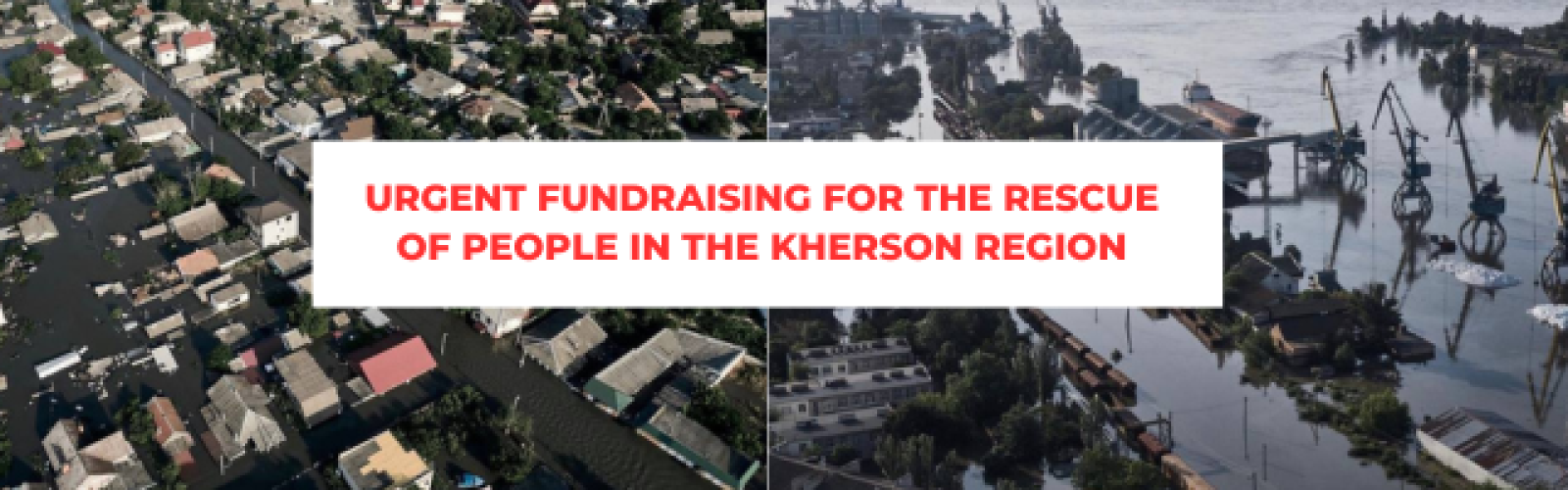
Urgent fundraising for the rescue of people in the Kherson region
"The only charitable foundation that the Kherson City Council collaborates with, which is completely transparent and provides assistance, is the Kherson Community Foundation 'Zakhyst.' It is this foundation that, within the 'Rescuing Kherson Together' program, has opened special accounts for both local currency and foreign currency, to which you can transfer funds to help the communities affected by the flooding," said the Head of the Kherson City Council Oleksandr Prokudin. He has recorded a video where he warns that criminals may take advantage of the situation. It has been two days since the Kakhovka Hydroelectric Power Station was destroyed by Russian forces. You can also help by making a donation in Global Giving platform here.
Below is an article from BBC News Ukraine, which has more information about Ukraine dam
https://www.bbc.com/news/world-europe-65818705
A huge dam in the Russian-controlled area of southern Ukraine has been destroyed, unleashing a flood of water.
Ukraine's military and Nato have accused Russia of blowing up the dam, while Russia has blamed Ukraine.
Thousands of people have been evacuated from communities in the surrounding areas, as catastrophic floods engulf low-lying areas either side of the river Dnipro.
Flood waters are expected to peak in the coming hours, but UN humanitarian aid chief Martin Griffiths is warning of grave and far-reaching consequences for thousands of people in the affected Kherson region.
Here's what we know so far.
Where is the dam?
The Kakhovka Hydroelectric Power Plant is in the city of Nova Kakhovka in the Kherson region. The city is currently under Russian occupation.
The dam was built in the Soviet era and is one of six that sit along the Dnipro river, which stretches all the way from the very north of the country into the sea in the south. In Kherson region, Russia occupies the left, or southern, bank while Ukraine controls the right, or northern, bank.
The dam holds back a reservoir equal in volume to the Great Salt Lake in the US state of Utah, according to Reuters. It's huge - locals call it the Kakhovka Sea as you cannot see the other bank in certain places.
What happened?
Stills and video showed a massive breach in the dam, with water surging through it and flooding downstream in the direction of Kherson.
It's unclear when exactly the dam was first damaged, but satellite images suggest its condition deteriorated over a number of days.
A road across the dam appears to be damaged from 2 June, but there did not seem to be a change to the flow of the water until 6 June when the breach of the wall and collapse of nearby buildings can be clearly seen. It is currently unclear whether the damage to the road is linked to the 6 June breach.
Satellite imagery shows massive flooding along low-lying areas either side of the Dnipro river.
Images from Nova Kakhovka on Tuesday showed buildings surrounded by floodwaters and even swans paddling around a local government office.
While water levels appear now to be dropping in Nova Kakhovka, further downstream in the city of Kherson they have not yet peaked.
In the town of Oleshky, residents say some homes are almost under water, with elderly people sitting on their roofs waiting to be evacuated.
The Russian-installed mayor of Nova Kakhovka said the village of Korsunka had been completely submerged, while in three other villages - Kozachi Laheri, Krynky and Dnipryany - were flooded up to their roofs.
Hundreds of people living in low lying parts of the city of Kherson, less than 50 miles downstream from Nova Kakhovka, have been evacuated, regional governor Oleksandr Prokudin said.
He added that almost 2,000 houses on the Ukrainian-controlled right bank of the river had been submerged.
Ukrainian hydro power dam operator UkrHydroEnerho said the Nova Kakhovka station was "fully destroyed" and could not be restored.
The river has also been contaminated with 150 tonnes of industrial lubricant, said President Volodymyr Zelensky, and another 300 tonnes was at risk of leaking.
There are concerns about desertification, with agricultural land washed away by flood waters and the negative consequences of the flooding likely to be felt for years.
Ukraine's agriculture ministry said 10,000 hectares of agricultural land on the Ukrainian-controlled side of the Dnipro had been flooded, and several times more on the Russian-occupied.